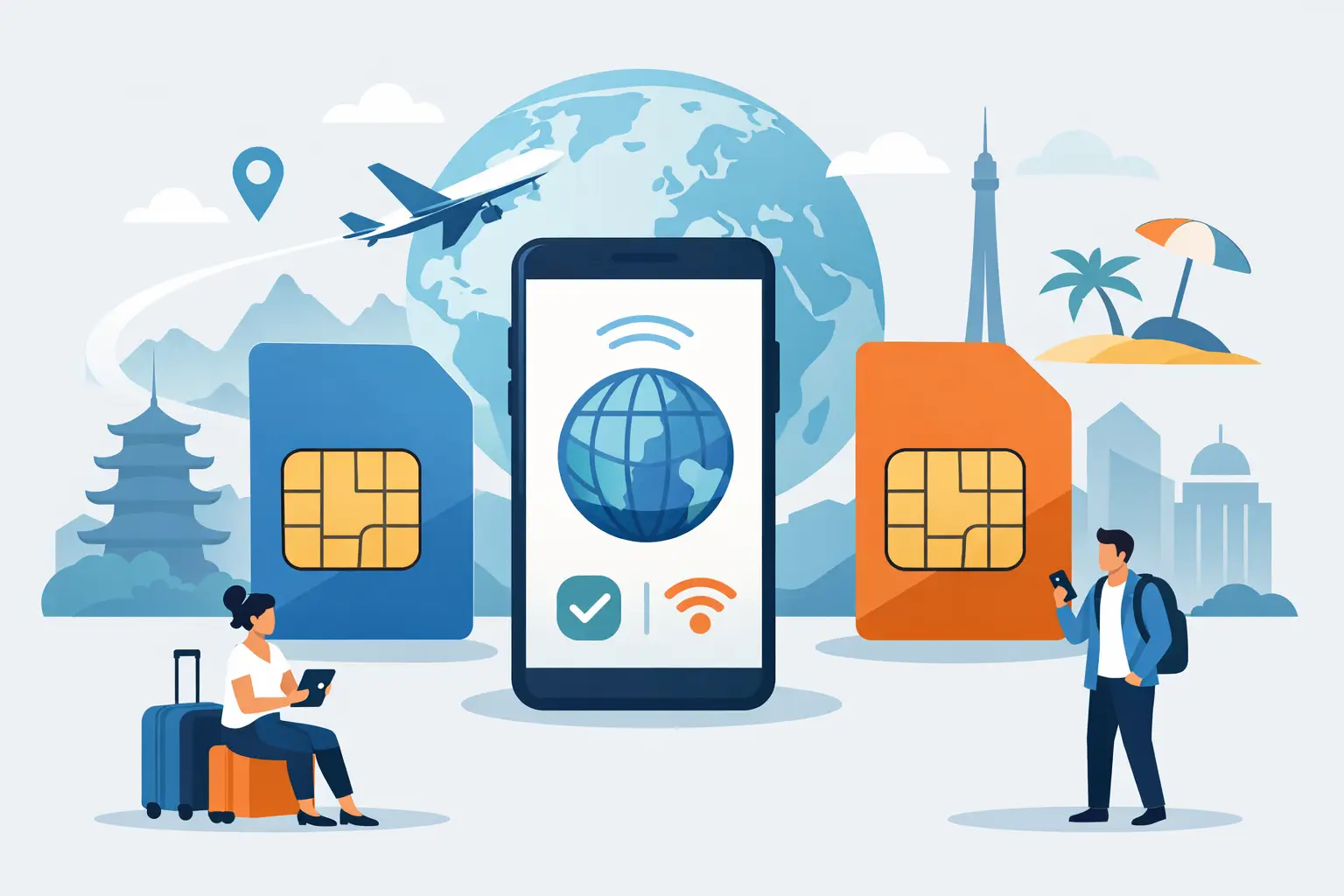
Arriver dans un nouveau pays avec 2% de batterie et sans données, c'est le meilleur moyen de payer trop cher. C'est pourquoi comparer les eSIM de voyage est important avant de partir, pas après avoir atterri. Le meilleur forfait n'est pas toujours celui qui porte le plus grand nom de marque ou le mot illimité en première page. C'est le forfait qui correspond à votre voyage, à votre téléphone et à votre budget.
Pour la plupart des voyageurs, la tâche est simple. Vous avez besoin de données pour les cartes, les messages, les applications de covoiturage, les confirmations de réservation et peut-être un hotspot pour un ordinateur portable. Vous voulez que tout soit disponible en quelques secondes, sans carte SIM physique, sans frais d'itinérance et sans majoration de borne aéroportuaire. Mais dès que vous commencez à comparer les forfaits eSIM, les différences deviennent plus significatives qu'elles ne le paraissent au premier abord.
Comment comparer les eSIM de voyage
Une bonne comparaison commence par le voyage lui-même. Un week-end à Paris n'a pas les mêmes besoins qu'un mois à travers l'Asie du Sud-Est. Un voyageur d'affaires qui n'a besoin que d'e-mails et de navigation peut acheter très différemment d'un travailleur à distance qui participe à des appels vidéo chaque jour.
Le premier filtre est la couverture de destination. Certains forfaits sont spécifiques à un pays, d'autres sont régionaux et d'autres sont mondiaux. Les forfaits par pays sont souvent les moins chers par gigaoctet si vous restez au même endroit. Les forfaits régionaux peuvent faire économiser de l'argent et des tracas si vous traversez des frontières. Les forfaits mondiaux semblent pratiques, mais ils coûtent souvent plus cher et ne sont pas toujours le meilleur rapport qualité-prix, sauf si votre itinéraire s'étend sur plusieurs régions.
Vient ensuite le volume de données. C'est là que les gens dépensent trop. Si vous utilisez principalement la messagerie, les cartes et la navigation légère, 3GB à 5GB peuvent suffire pour une semaine. Si vous diffusez des vidéos, téléchargez du contenu ou partagez la connexion avec un autre appareil, vous les épuiserez rapidement. Les forfaits plus importants ne sont pas automatiquement meilleurs. La décision la plus judicieuse est d'adapter le forfait à votre utilisation réelle.
La validité est tout aussi importante que les données. Un forfait 5GB bon marché qui expire en 7 jours est un mauvais choix pour un voyage de 12 jours si vous devez recharger en cours de route. En revanche, payer en supplément pour 30 jours quand vous partez seulement quatre nuits, c'est de l'argent gaspillé. Dans toute comparaison d'eSIM de voyage, le prix n'a de sens que si l'on examine conjointement les données et la validité.
Il y a aussi la qualité du réseau. La plupart des voyageurs ne se soucient pas de l'opérateur local qui se trouve derrière l'eSIM jusqu'à ce que les vitesses soient lentes ou que la couverture disparaisse en dehors des villes. Certains forfaits eSIM utilisent des réseaux locaux premium. D'autres acheminent le trafic via des partenariats moins favorables. Si votre voyage inclut des zones rurales, des îles ou de longs trajets en train, l'accès au réseau mérite plus d'attention qu'une simple remise promotionnelle.
Ce qui rend réellement un eSIM moins cher
Le prix affiché le plus bas peut être trompeur. Un forfait à $4 semble excellent jusqu'à ce que vous réalisiez qu'il n'inclut que 1GB pour trois jours. Un forfait à $9 avec 5GB pour 15 jours peut être l'option la moins chère en pratique.
La façon la plus simple d'évaluer la valeur est le coût par gigaoctet, puis vérifier si la durée du forfait correspond à votre voyage. Mais même cela a ses limites. Les forfaits illimités, par exemple, sont souvent assortis de politiques d'utilisation raisonnable ou de limitations de vitesse après un seuil quotidien. Ils sont utiles pour les gros consommateurs, mais ils ne sont pas toujours véritablement illimités comme les voyageurs s'y attendent.
C'est également là que les places de marché de comparaison peuvent aider. Au lieu de promouvoir les forfaits d'un seul fournisseur, elles présentent différentes offres côte à côte, ce qui rend les écarts de prix évidents. CheapereSIM est construit autour de cette logique - comparez d'abord, puis achetez l'option la moins chère qui correspond vraiment à votre voyage.
Comparaison des eSIM de voyage par type de forfait
Les forfaits par pays gagnent généralement sur le prix. Si vous partez au Japon pour une semaine et que vous y restez, un eSIM uniquement pour le Japon sera souvent moins cher qu'un forfait Asie régional. La contrepartie est la flexibilité. Si vous ajoutez une escale en Corée du Sud ou à Singapour, vous aurez peut-être besoin d'un deuxième eSIM.
Les forfaits régionaux sont pratiques pour les voyages dans plusieurs pays. L'Europe est l'exemple le plus courant. Si votre voyage couvre l'Italie, la France et l'Espagne, un seul eSIM régional est plus simple que de gérer des forfaits séparés. Vous paierez peut-être un peu plus qu'une option pour un seul pays, mais vous éviterez les lacunes lors du passage des frontières.
Les forfaits mondiaux sont les mieux adaptés aux voyageurs aux emplois du temps imprévisibles, aux grands voyageurs ou aux longs voyages sur plusieurs continents. Ils privilégient avant tout la commodité. Si le budget est votre priorité absolue, ce n'est généralement pas la solution la moins chère.
Les forfaits illimités journaliers conviennent bien aux personnes qui utilisent beaucoup de données et ne veulent pas surveiller leur consommation. Mais lisez les détails. Certains forfaits ralentissent après 1GB, 2GB ou 3GB par jour. C'est encore suffisant pour les cartes et la messagerie, mais pas idéal si vous vous attendez à un partage de connexion à pleine vitesse toute la journée.
Les forfaits à données fixes sont plus faciles à comparer car le calcul est plus simple. Vous voyez le volume de données, la période de validité et le coût total. Pour les voyageurs qui souhaitent des dépenses prévisibles, ces forfaits sont souvent le choix le plus sûr.
Erreurs courantes des voyageurs
Une erreur courante est d'acheter trop tard. Si vous attendez d'être arrivé et que le Wi-Fi de l'aéroport est faible, même une simple configuration par code QR devient plus stressante qu'elle ne devrait l'être. Acheter avant le départ vous permet de confirmer la compatibilité et d'installer l'eSIM pendant que vous disposez encore d'une connexion internet stable.
Une autre erreur est d'ignorer la compatibilité du téléphone. La plupart des nouveaux iPhone, des appareils Google Pixel et de nombreux modèles Samsung prennent en charge l'eSIM, mais ce n'est pas le cas de tous les téléphones. Certains appareils verrouillés par un opérateur posent également des problèmes. Une vérification rapide de la compatibilité peut éviter bien des frustrations.
Les voyageurs sont également trompés par les règles d'activation. Certains forfaits s'activent lors de l'installation. D'autres ne démarrent que lorsqu'ils se connectent à un réseau compatible à destination. Cette différence est importante. Installer trop tôt le mauvais type de forfait peut faire démarrer le décompte de validité avant même que votre voyage ne commence.
La dernière erreur est de supposer qu'illimité signifie sans limites. Cela peut quand même être la bonne option, mais vérifiez toujours les restrictions de débit, les limitations du hotspot et les conditions d'utilisation raisonnable.
Ce qu'il faut comparer avant d'acheter
Si vous voulez prendre une décision d'achat plus rapide, concentrez-vous sur cinq éléments : la couverture de destination, le volume total de données, le nombre de jours de validité, la qualité du réseau et le prix total. Cela semble évident, mais la plupart des mauvais achats surviennent parce que les voyageurs ne comparent qu'un seul de ces cinq critères.
Le prix doit venir en dernier, pas en premier. Une fois que vous avez confirmé que le forfait couvre votre destination, correspond à votre utilisation et dure tout votre voyage, comparez ensuite le coût. Cette approche évite le problème des fausses bonnes affaires, où le forfait le moins cher finit par coûter plus cher parce que vous avez besoin d'une recharge.
Il est également utile de penser à votre jour d'arrivée. Si vous avez besoin de données dès que vous atterrissez pour les formulaires d'immigration, les trajets ou l'enregistrement à l'hôtel, la livraison instantanée est importante. Un eSIM numérique envoyé par code QR en quelques secondes est un vrai avantage pratique, pas seulement un argument marketing.
Meilleure option selon le type de voyageur
Les voyageurs économes font généralement le meilleur choix avec des forfaits par pays à données fixes. Ils sont plus faciles à contrôler et offrent souvent les dépenses totales les plus basses. Si votre voyage est court et votre utilisation légère, il n'y a aucune raison de payer pour une flexibilité que vous n'utiliserez pas.
Les grands voyageurs et les voyageurs d'affaires peuvent préférer les options régionales ou mondiales car la commodité est importante. Économiser cinq dollars est moins significatif si cela implique d'acheter un nouvel eSIM à chaque changement de pays.
Les nomades numériques et les grands consommateurs de données se tournent souvent vers des forfaits de données plus importants ou des forfaits illimités journaliers. Le compromis clé est la politique de vitesse. Si votre travail dépend de données stables à haute vitesse, un forfait à données fixes important peut être meilleur qu'un forfait illimité avec une limitation de vitesse agressive.
Les étudiants à l'étranger et les voyageurs en séjour prolongé doivent se méfier des forfaits touristiques à courte validité. Une carte SIM locale ou un eSIM à plus long terme peut être moins cher sur un mois entier ou un semestre. Les eSIM de voyage sont les plus avantageux lorsque la vitesse, la commodité et la flexibilité à court terme sont les plus importantes.
La façon intelligente de choisir
La meilleure comparaison d'eSIM de voyage ne consiste pas à trouver un gagnant universel. Il s'agit de trouver le forfait le moins cher qui correspond exactement à votre voyage sans compromis cachés. Pour un voyageur, c'est un forfait par pays de 3GB. Pour un autre, c'est un forfait régional avec couverture aux frontières. Pour quelqu'un d'autre, la bonne réponse est un forfait illimité avec un plafond journalier clair.
Si vous comparez avec cet état d'esprit, vous évitez de payer pour la notoriété d'une marque, des promesses vagues ou des fonctionnalités que vous n'utiliserez jamais. Vous obtenez des données qui fonctionnent dès votre arrivée, à un prix qui a du sens avant d'embarquer. C'est généralement la différence entre un achat de voyage que vous oubliez et un que vous regrettez à mi-chemin de votre voyage.
Avant d'acheter, prenez une minute supplémentaire pour adapter le forfait à la façon dont vous voyagez réellement. C'est dans cette minute que se trouvent la plupart des économies.