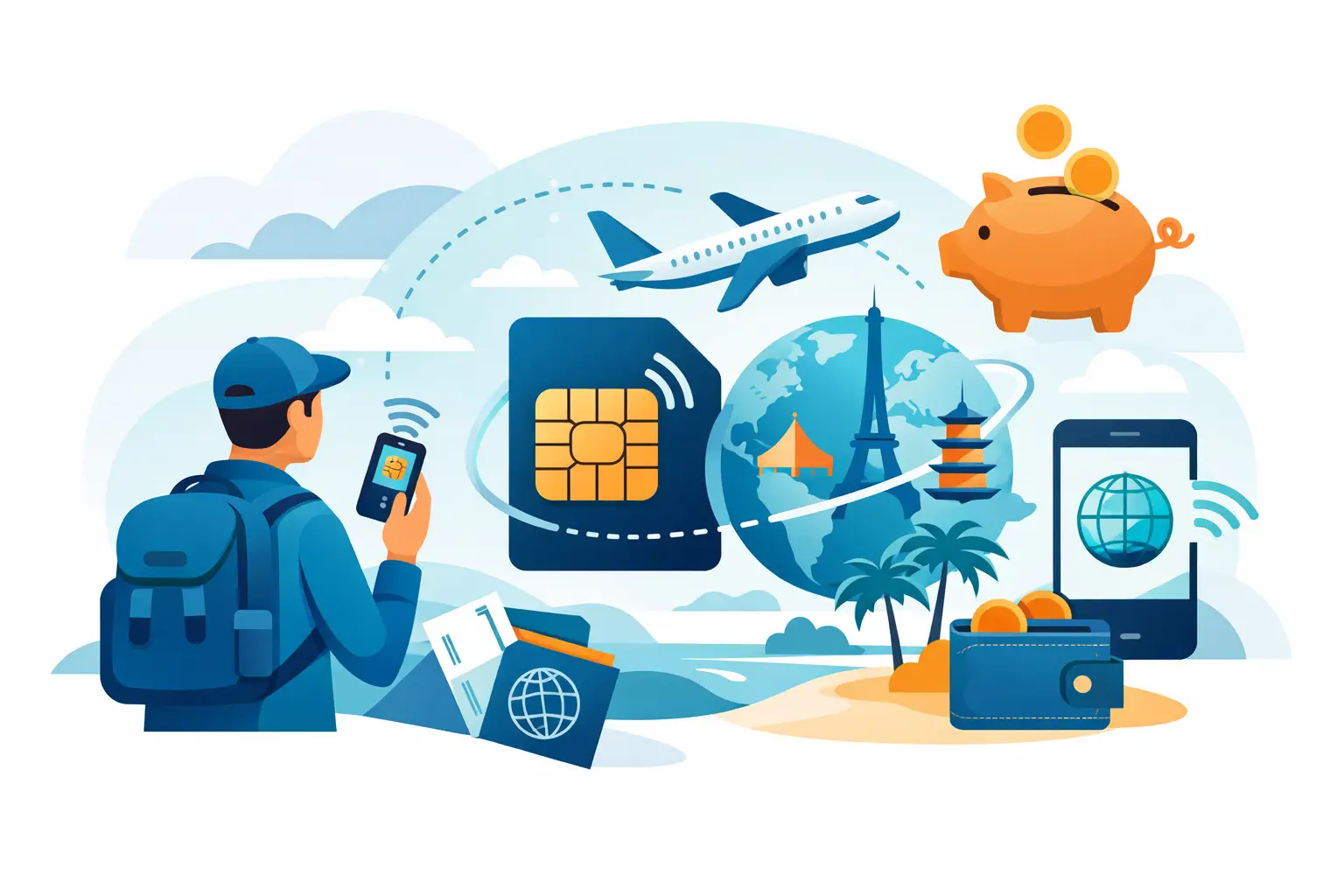
Atterrir après un long vol est le pire moment pour réaliser que votre téléphone n'a pas de données. Vous avez besoin d'un itinéraire, d'un taxi, de votre réservation d'hôtel, et peut-être d'envoyer un message à la maison. C'est exactement là qu'un guide de voyage international eSIM aide - non pas avec du jargon technique, mais avec le moyen le plus rapide de se connecter sans payer les tarifs d'itinérance.
Un eSIM est une SIM numérique intégrée à de nombreux téléphones récents. Au lieu d'acheter une carte plastique à l'aéroport ou de changer votre SIM habituelle, vous achetez un forfait en ligne, scannez un code QR et l'installez en quelques minutes. Pour la plupart des voyageurs, cela signifie pas de visite en magasin, pas d'attente en file, et pas de frais surprises de votre opérateur.
L'attrait est simple : coût réduit, configuration plus rapide et plus de contrôle. Mais tous les forfaits eSIM ne se valent pas. Les prix, la couverture, la vitesse et les limites de données peuvent varier considérablement selon votre destination et votre utilisation du téléphone.
Ce qu'un guide de voyage international eSIM doit vous aider à décider
La question principale n'est pas de savoir si l'eSIM est pratique. C'est de savoir si le forfait que vous choisissez correspond réellement à votre voyage.
Si vous faites une courte escapade en ville, un petit forfait à données fixes peut être l'option la moins chère. Si vous travaillez à distance, utilisez le partage de connexion ou streamez en déplacement, un forfait illimité ou à haute capacité peut avoir plus de sens même si le prix initial est plus élevé. Le forfait le moins cher n'est une bonne affaire que s'il couvre votre façon de voyager.
La destination compte aussi. Un forfait pour un seul pays est souvent moins cher qu'un forfait régional, mais la couverture régionale peut valoir la peine si vous traversez des frontières. Quelqu'un qui visite uniquement le Japon pendant une semaine ne devrait généralement pas payer extra pour un forfait couvrant toute l'Asie. Quelqu'un qui se déplace entre la France, l'Italie et l'Espagne le devrait probablement.
C'est pourquoi la comparaison est importante. Une approche de marketplace est utile ici car les tarifs pour la même destination peuvent beaucoup différer selon les fournisseurs. CheapereSIM se concentre sur cet écart de prix en mettant en avant les options moins coûteuses plutôt qu'en poussant les forfaits d'un seul opérateur dans chaque pays.
Comment les eSIM de voyage fonctionnent en pratique
La plupart des achats d'eSIM de voyage suivent le même processus. Vous choisissez une destination, sélectionnez une quantité de données ou une durée, finalisez le paiement et recevez un code QR en quelques secondes. Vous ajoutez ensuite l'eSIM à votre téléphone via les paramètres, lui donnez un nom et basculez les données mobiles sur cette ligne au début de votre voyage.
Dans de nombreux cas, vous pouvez installer l'eSIM avant le départ et l'activer à l'atterrissage. Cela supprime un problème de plus à l'aéroport. Vous descendez de l'avion, désactivez l'itinérance sur votre opérateur habituel, activez l'eSIM de voyage pour les données et vous connectez immédiatement.
Il y a quelques compromis à connaître. La plupart des forfaits eSIM de voyage sont uniquement données, ce qui convient aux voyageurs utilisant iMessage, WhatsApp, FaceTime, Google Maps, Uber et les e-mails. Mais si vous avez besoin d'un numéro de téléphone local traditionnel pour les appels ou les SMS, vous devez vérifier attentivement les détails du forfait. Certains voyageurs ne remarquent jamais la différence. D'autres, notamment en voyage d'affaires, peuvent s'en soucier beaucoup.
Guide de voyage international eSIM pour choisir le bon forfait
Commencez par trois choses : les pays, les jours et vos habitudes de consommation de données.
Si votre voyage dure moins d'une semaine et que votre utilisation du téléphone est légère, 1 GB à 3 GB peut suffire pour les messages, les cartes et la navigation occasionnelle. Si vous partagez des photos, utilisez régulièrement les réseaux sociaux ou dépendez de votre téléphone toute la journée, 5 GB à 10 GB est plus réaliste. Si vous prévoyez d'utiliser le partage de connexion pour un ordinateur portable ou de streamer des vidéos, les forfaits à données fixes peuvent s'épuiser rapidement.
La durée compte autant que les données. Certains forfaits durent 7 jours, d'autres 15, d'autres 30. Si votre date de retour change, un forfait qui semblait moins cher peut devenir coûteux si vous devez le recharger. Payer légèrement plus pour une période de validité plus longue peut être le meilleur choix budgétaire.
Vérifiez ensuite si le forfait est local, régional ou mondial. Les forfaits locaux gagnent généralement sur le prix. Les forfaits régionaux font gagner du temps si vous visitez plusieurs pays. Les forfaits mondiaux sont pratiques pour les longs voyages avec plusieurs escales, mais ils ne sont pas toujours le choix le moins coûteux.
Une bonne règle est simple : achetez pour votre vrai itinéraire, pas pour un itinéraire hypothétique. Les voyageurs paient souvent trop cher pour une couverture plus large qu'ils n'utilisent jamais.
Compatibilité et configuration sans les complications
Avant d'acheter, vérifiez que votre téléphone prend en charge l'eSIM et qu'il est déverrouillé. La plupart des iPhone récents, des téléphones Google Pixel et de nombreux modèles Samsung Galaxy le prennent en charge, mais toutes les versions sur tous les marchés ne le supportent pas. Les téléphones verrouillés sont un problème courant, notamment pour les voyageurs américains sous contrat à paiements échelonnés.
Une fois la compatibilité confirmée, la configuration est généralement simple. Installez l'eSIM à partir du code QR, gardez votre ligne principale active si vous souhaitez continuer à recevoir vos SMS habituels, et basculez les données cellulaires vers l'eSIM de voyage. Désactivez l'itinérance de données sur votre ligne habituelle pour que votre opérateur ne vous facture pas discrètement.
Vous devriez également étiqueter clairement vos lignes. Quelque chose comme SIM Domicile et eSIM Voyage simplifie les choses quand vous êtes fatigué, en transit ou en train de modifier les paramètres à la hâte.
Si votre forfait le prend en charge, activez le mode données faibles ou surveillez votre consommation dans les paramètres de votre téléphone. C'est particulièrement utile avec les forfaits à données fixes. L'actualisation des applications en arrière-plan, la synchronisation des photos dans le cloud et les mises à jour automatiques peuvent consommer les données plus vite que la plupart des gens ne le pensent.
Ce que les voyageurs se trompent généralement sur les prix des eSIM
La plus grande erreur est de comparer uniquement le prix affiché. Un forfait à $4 qui dure trois jours ou donne très peu de données n'est pas moins cher si vous devez l'acheter deux fois. D'un autre côté, les forfaits illimités ne sont pas toujours l'aubaine qu'ils semblent être si vous n'avez besoin que de cartes et de messagerie pour un week-end.
La deuxième erreur est d'ignorer la qualité du réseau à destination. L'option la moins chère n'est pas utile si les vitesses sont mauvaises là où vous séjournez réellement. Cela importe davantage dans les zones rurales, les îles et les pays où la qualité des fournisseurs varie fortement selon les régions.
La troisième erreur est d'attendre jusqu'à l'arrivée. Vous pouvez acheter à l'aéroport, mais les options en aéroport sont rarement les mieux tarifées, et le Wi-Fi public n'est pas le moment idéal pour comparer des forfaits ou résoudre des problèmes de configuration. Acheter avant le départ est généralement la solution la plus simple.
Quand un eSIM est meilleur que l'itinérance ou une SIM locale
Pour la plupart des courts séjours, l'eSIM est plus avantageux que l'itinérance en termes de prix et de commodité. L'itinérance depuis un opérateur américain peut être acceptable pour un jour en cas d'urgence, mais sur une semaine ou deux, cela devient souvent une habitude coûteuse.
Comparé à une SIM physique locale, l'eSIM est généralement plus rapide et plus facile. Pas de petit tiroir à ouvrir, pas de risque d'égarer votre SIM habituelle, et pas besoin de trouver un magasin après l'atterrissage. Cela dit, une SIM locale peut encore avoir du sens pour des séjours plus longs si vous avez besoin d'un numéro local, de très grandes allocations de données ou d'accès à un opérateur domestique spécifique.
Pour les voyageurs visitant plusieurs pays, l'eSIM est particulièrement pratique. Vous pouvez garder votre numéro habituel actif, utiliser les données à l'étranger et éviter d'acheter une nouvelle SIM à chaque fois que vous franchissez une frontière.
Qui bénéficie le plus de ce guide de voyage international eSIM
Les grands voyageurs en bénéficient car ils peuvent s'installer rapidement et répéter le processus voyage après voyage. Les étudiants à l'étranger apprécient le coût initial plus bas et la possibilité de gérer les forfaits numériquement. Les routards aiment éviter les frais d'itinérance tout en contrôlant leurs dépenses. Les voyageurs d'affaires apprécient d'être connectés dès l'atterrissage.
Même les vacanciers occasionnels en bénéficient s'ils dépendent de la navigation, des applications de VTC, des réservations de restaurants, des outils de traduction et de la messagerie. C'est la plupart des gens maintenant.
La vraie valeur n'est pas seulement la connectivité. C'est l'élimination d'une contrainte de voyage supplémentaire au moment où vous avez le plus besoin de votre téléphone.
Une façon plus intelligente d'acheter avant de prendre l'avion
Si vous voulez le meilleur résultat, ne choisissez pas uniquement par nom de marque. Comparez par destination, quantité de données, validité et coût total. Recherchez une livraison claire, une activation simple et une couverture réaliste pour les endroits que vous visitez vraiment. Une configuration rapide compte, mais une tarification transparente compte encore plus.
Un eSIM de voyage devrait sembler simple parce qu'il l'est quand il est bien choisi. Pas de SIM physique. Pas de frais d'itinérance. Livré en quelques secondes. C'est la norme à viser.
Avant votre prochain voyage, prenez cinq minutes pour choisir le bon forfait pendant que vous avez encore un Wi-Fi fiable et le temps de réfléchir. C'est une petite étape qui peut économiser de l'argent, réduire le stress et rendre l'arrivée beaucoup plus facile.